Flatbed or Wheel-Lift: What Truck Picks Up a Junk Car?
By Junk Cars Gary · Updated
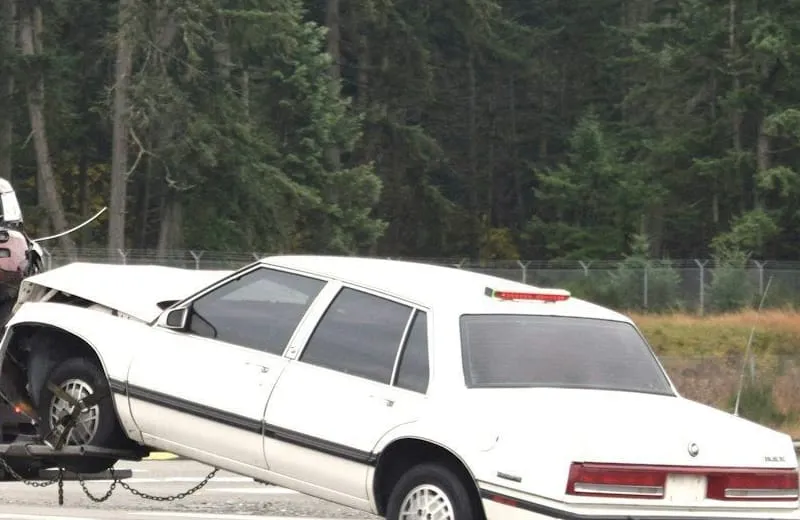
A junk car is picked up on a flatbed, lifted by one axle with a wheel-lift, or winched out first if it's stuck. Which one fits depends on the car: whether it rolls, whether it steers, the tires, and the drivetrain. Knowing the difference helps you describe your car so the pickup goes right the first time.
What truck picks up a junk car?
- Flatbed (rollback): the bed tilts down and the car is winched onto it. Suits cars that can’t roll, wrecked cars and many all-wheel-drive vehicles.
- Wheel-lift: lifts one axle and tows the car on its other two wheels. Quicker, but it needs a car that rolls and steers.
- Winch-out: pulls a car out of a garage, yard or ditch first, before it’s loaded.
The photo above shows a wheel-lift at work: a crashed sedan lifted by its front wheels behind a flatbed that’s already carrying another car.
Flatbed (rollback)
A flatbed’s bed slides back and tilts until its end touches the ground. A winch cable hooks to the car and pulls it up the ramp, and the car rides home with all four wheels off the road.
That’s why it’s the default for junk cars. A car with a seized engine, a locked transmission, flat tires or a bent wheel doesn’t need to turn a single wheel to get on a flatbed. It only needs to slide. Wrecked cars with body damage near the wheels go the same way.
The limits are space and angle. A flatbed needs room to park in line with the car and lower its bed, and a very low car can scrape on the way up.
Wheel-lift
A wheel-lift slides a cradle under one pair of wheels, lifts that end of the car, and tows it on the other two. It’s quicker to hook up and works in tighter spots than a flatbed, since it doesn’t need to lay a long bed down.
The catch is the two wheels still on the road. They have to turn freely and track straight, so the car needs good tires on that axle, working wheel bearings, and brakes that aren’t seized. Many all-wheel-drive cars shouldn’t be towed with any wheels turning at all; the owner’s manual says how your car can be towed.
Winching a car out first
Some cars aren’t where a truck can reach them: deep in a garage, behind a house, nose-down in a ditch. Before any loading, the car gets winched out in a straight line to firm ground. This is where your description matters most, because a winch-out depends on the path: door width, obstacles, ground surface and distance.
Which setup fits your car?
| Your car | What usually fits |
|---|---|
| Rolls, steers, good tires | Wheel-lift or flatbed |
| Won’t roll (seized, stuck in park, brakes locked) | Flatbed |
| Flat tires or a bent wheel | Flatbed, winched on |
| All-wheel drive | Flatbed, unless the manual allows otherwise |
| In a garage, backyard or ditch | Winched out first, then loaded |
What to tell the buyer before pickup
Nobody expects you to know tow gear. What helps is a plain description of the car: whether it rolls in neutral, whether it steers, which tires are flat, two- or all-wheel drive if you know it, and where it’s parked. With Junk Cars Gary, that description is how the pickup is planned, and junk car towing in Gary is free.
If the car is stuck inside a garage or out back, read getting a dead car out of a garage or backyard first. It covers the prep that makes any of these setups quicker.
Quick answers
Is a flatbed better for towing?
For a car that can't roll, has damaged wheels or is all-wheel drive, usually yes, because all four wheels ride off the ground. For a car that rolls and steers over a short distance, a wheel-lift does the job.
Are wheel-lift tow trucks good for long distances?
They can be, for a car whose wheels, tires and drivetrain are in good shape. The two wheels on the ground are turning the whole way, so a damaged car is better off on a flatbed.
What should I tell the buyer before a junk car is picked up?
Whether it rolls in neutral, whether it steers, which tires are flat, whether it's two- or all-wheel drive if you know, and exactly where it's parked.